


Project Details
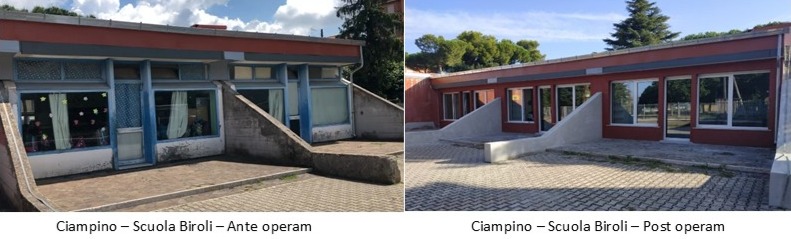
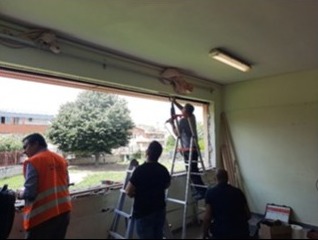
Executive design, construction management, measurement and accounting of the works, coordination during the design and execution phase relating to the acoustic remediation interventions of school buildings located in the municipalities of Ciampino and Marino
DESCRIPTION OF THE PROJECT
In May 2019, VDP won the tender launched by Aeroporti di Roma SpA for a framework contract covering the executive design, construction management, measurement and accounting of the works, and coordination during the design and execution phases relating to the acoustic remediation of school buildings located in the municipalities of Ciampino and Marino.
Having completed the work in 2020, VDP won a further framework agreement in 2021, which was completed in 2025.
The work was drawn up in accordance with the Ciampino Airport Noise Containment and Abatement Plan (PCAR), approved by Ministerial Decree no. 345 of 18 December 2018 by the Ministry of the Environment and in compliance with requirements 1, 2 and 9 of Annex A to Ministerial Decree 345/2018. These requirements concerned, in particular, direct interventions in school buildings where exceedances of the relevant limit values were found and in any case on those included in the areas of respect A and B of the airport surroundings. These interventions had to ensure compliance with the acoustic performance relating to the sound insulation of building facades, as referred to in the Prime Ministerial Decree. 5/12/1997.
In accordance with these regulations, the interventions designed and then implemented, which were overseen by the Construction Management and Safety Coordination, aimed to achieve a façade sound insulation value greater than or equal to 48 dB; this was achieved both by replacing the fixtures with high-performance ones and by interventions on the external wall partitions.
The calculation of the acoustic insulation of the façade with reverberation time has always been carried out, according to UNI EN ISO 12354-3, with identification of the building elements to be created in order to ensure the acoustic climate of the school complex.
It is also specified that other non-acoustic regulatory standards such as brightness, ventilation and transmittance were also considered in the design. In some cases, the interventions also involved external and/or internal improvements to the building which, although not strictly required by the acoustic project, contributed to the overall redevelopment of the school structure.
PROJECT SPECIFICITY
Overall, 9 school buildings were the subject of executive planning and subsequent construction management, of which:
- 5 in the municipality of Ciampino, for a total of 181 fixtures and corresponding 1,333 m2 of windows replaced.
- Leonardo da Vinci Comprehensive Institute – Pirzio Biroli Primary School
- Leonardo da Vinci Comprehensive Institute – Secondary School
- Paola Sarro Primary and Nursery School
- Axel Municipal Nursery School
- Carlo Collodi Municipal Nursery School
- 4 in the municipality of Marino, for a total of 237 fixtures and corresponding 713 m2 of windows replaced.
- Bruno Ciari Nursery School
- Primo Levi Middle School
- Giuseppe Verdi Primary School
- Santa Chiara Private School